Agent-as-Tool Delegation
Agents can call other agents as tools, enabling coordinator patterns where a supervisor delegates tasks to specialized workers.
Setup
Define a coordinator agent that lists other agents in its agents primitive:
agents:
  specs:
    researcher:
      model: "us.anthropic.claude-sonnet-4-20250514-v1:0"
      description: "Researches topics using memory and web"
      primitives:
        memory: { enabled: true }
        browser: { enabled: true }

    coder:
      model: "us.anthropic.claude-sonnet-4-20250514-v1:0"
      description: "Writes and executes code"
      primitives:
        code_interpreter: { enabled: true }

    coordinator:
      model: "us.anthropic.claude-sonnet-4-20250514-v1:0"
      description: "Delegates to researcher and coder"
      system_prompt: |
        You coordinate specialized agents. Delegate tasks by calling
        call_researcher or call_coder. Make parallel calls when tasks
        are independent.
      primitives:
        memory: { enabled: true }
        agents:
          enabled: true
          tools: ["researcher", "coder"]
What the Coordinator Sees
The coordinator's LLM receives these tools:
| Tool | Description |
|---|---|
call_researcher(message) |
Delegate a task to the 'researcher' agent |
call_coder(message) |
Delegate a task to the 'coder' agent |
remember(key, content) |
Store information (from memory primitive) |
How It Works
- Coordinator calls
call_researcher(message="What are the top 3 Python frameworks?") - The gateway runs
AgentRunner.run()for the researcher agent (with incremented depth) - The researcher uses its own tools (memory, browser) to answer
- The researcher's response + tool artifacts are returned to the coordinator
- The coordinator synthesizes and responds to the user
Parallel Delegation
The coordinator can call multiple agents simultaneously:
Coordinator LLM response:
  tool_use: call_researcher(message="Research Python frameworks")
  tool_use: call_coder(message="Write a hello world benchmark")

Both run in parallel via asyncio.gather
The coordinator's system prompt should encourage this:
When tasks are independent, call multiple agents in parallel
by making multiple tool calls in the same response.
Depth Limiting
To prevent infinite recursion (A calls B calls A), delegation depth is tracked:
MAX_AGENT_DEPTH = 3- Each delegation increments depth
- At max depth, the agent returns an error message instead of running
Streaming
In streaming mode, sub-agent events are forwarded to the parent:
| Event | Description |
|---|---|
sub_agent_token |
Token from a sub-agent (streamed to UI) |
sub_agent_tool |
Sub-agent using a tool (e.g., "using execute_code") |
tool_call_result |
Delegation complete (triggers "done" state in UI) |
The UI shows collapsible sub-agent activity blocks with real-time content.
Artifacts
When a sub-agent uses tools (e.g., execute_code), the code and output are captured as artifacts and returned to the coordinator. This ensures the coordinator LLM has the actual code, not just a summary.
Provider Overrides
Each agent uses its own provider_overrides. When the coordinator delegates to the researcher:
- The coordinator's overrides are saved
- The researcher's overrides are merged on top
- After the researcher finishes, the coordinator's overrides are restored
This ensures each agent talks to its configured providers.
Dynamic Delegation (Meta-Agent)
Instead of pre-defining sub-agents, use agent_management to create them at runtime:
The meta-agent gets create_agent, delegate_to, delete_agent, list_agents, and list_primitives tools. It can:
- Discover available primitives via
list_primitives - Create a specialist with
create_agent(name, system_prompt, primitives='{"browser": {"enabled": true}}') - Delegate via
delegate_to(agent_name, message)— works with just-created agents - Clean up with
delete_agent
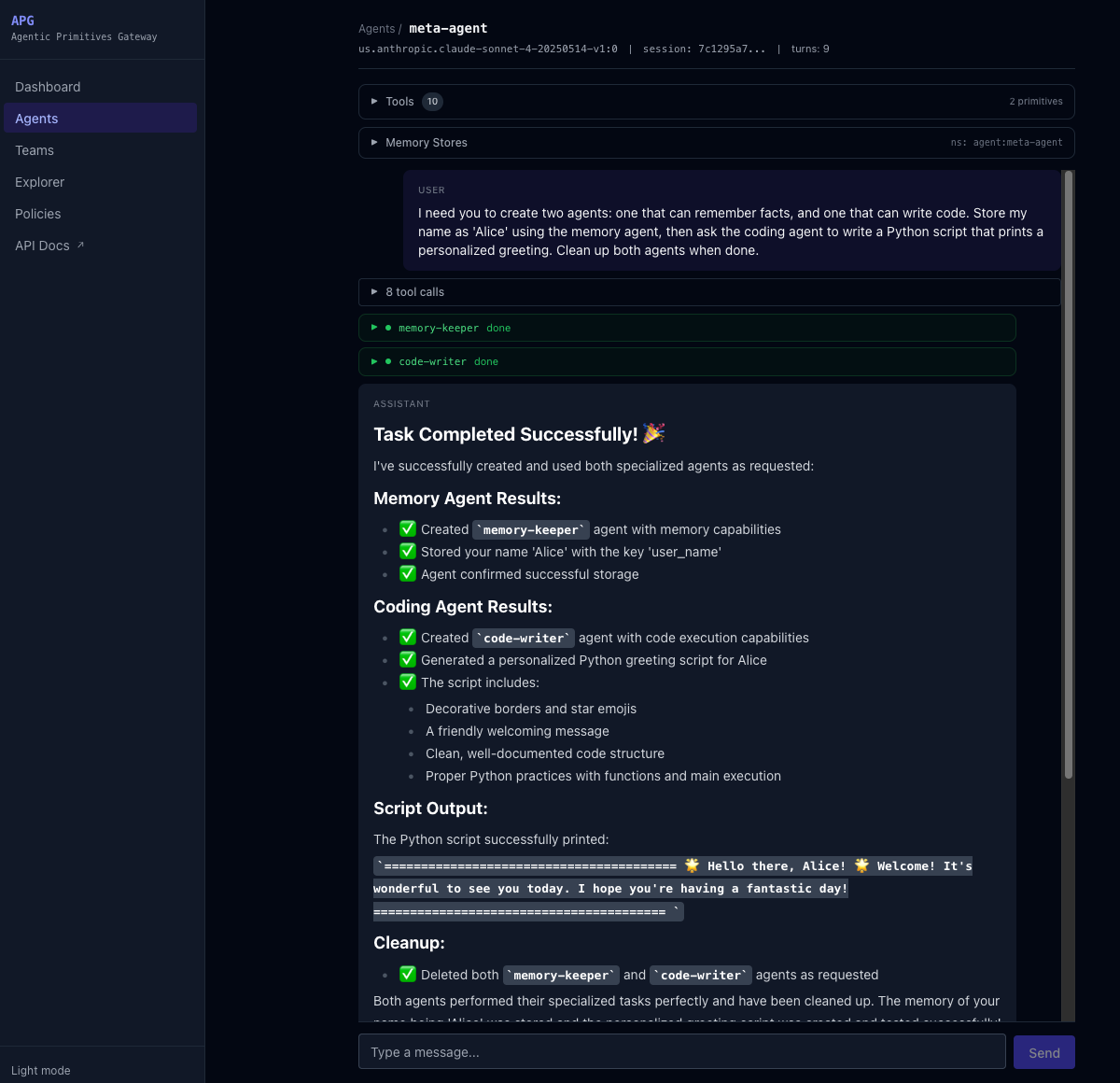
delegate_to provides the same streaming sub-agent experience in the UI as static call_* delegation — activity panels, tool badges, and green completion indicators.
Comparison
| Feature | Static Delegation | Dynamic (Meta-Agent) | Agent Teams |
|---|---|---|---|
| Sub-agents | Pre-defined in config | Created at runtime | Pre-defined workers |
| Coordination | Coordinator calls sub-agents | Meta-agent designs + delegates | Task board + planner |
| Parallelism | Coordinator decides | Meta-agent decides | Workers claim independently |
| Replanning | Manual | Manual | Automatic (continuous) |
| Best for | Known 2-3 agent workflows | Unknown/novel tasks | Complex multi-step collaboration |